Begin with the invitation
A community cricket afternoon can mean a match, a coached introduction, an informal practice or a gathering where most people watch. Those are different experiences. Before deciding whether an event suits you, find the actual organiser's description and establish which one is being offered. A photograph of a crowded field does not answer the question. Neither does a familiar sporting name. Look for the activity, its intended participants, the place and the person responsible for explaining the arrangements.
This field note is a reading guide, not an invitation to an event run by this website. LifeSport Canada does not collect donations or provide a booking service here. The retained address belongs to an earlier edition; the current article concerns the questions that make a cricket introduction understandable. You can return to the LifeSport Canada fieldbook for a broader explanation of watching the game before choosing a particular session.
Separate a match from a practice
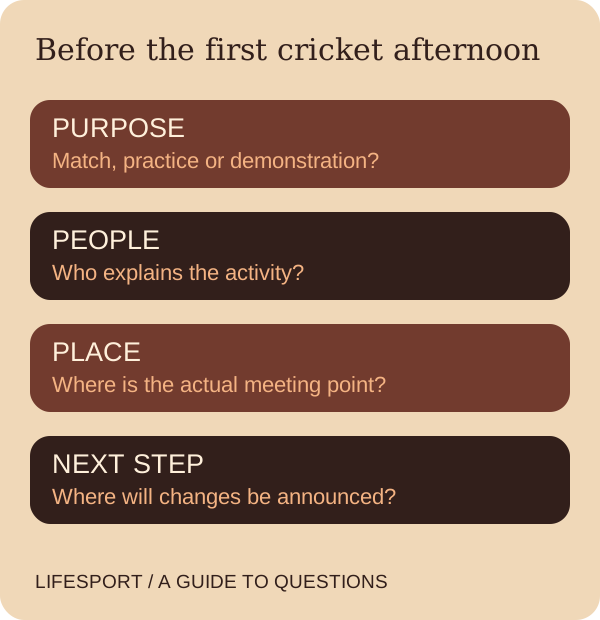
A match has a result to pursue under an agreed set of rules. A practice can pause, repeat an exercise and change the task to help people learn. A demonstration might involve only a few people while everyone else observes. If an invitation uses these descriptions interchangeably, ask what participants actually spend their time doing. A beginner expecting repeated turns with the bat could have a very different afternoon at a competitive match with established teams.
None of these arrangements is automatically better. The useful question is whether the purpose matches your expectations. Someone curious about field positions may enjoy observing a match with an explanation. Someone trying a movement for the first time may prefer a clearly supervised introduction. The organiser should describe the experience without requiring you to infer it from promotional language. Record that answer alongside the advertised duration, rather than treating duration alone as a measure of value.
Ask who explains the first five minutes
An unfamiliar sport becomes easier to follow when somebody states the immediate task in ordinary language. Who will say where newcomers should wait? Who explains when an activity begins and ends? Is there an opportunity to ask a question before joining? These details are more useful than an assurance that everyone already loves the game. Welcoming language needs practical information behind it, particularly when an invitation reaches people who have never visited the venue.
The same principle applies to watching. A short introduction can identify the batting side, the fielding side and the visible scoreboard without teaching every possible dismissal. As an observer, choose one question at a time. Ask what changed in the score after a delivery, then connect that change with what you saw. There is no need to pretend you understood an explanation. Asking for the same idea in simpler words is a reasonable part of learning.
Read the proposed sequence
Imagine an invented introduction with three parts: an explanation, a demonstration and an opportunity for questions. That sequence offers a useful way to inspect an invitation, but it is not a recommended timetable or a claim about an actual programme. Ask whether the advertised session has its own sequence and whether participants can understand it in advance. A clear order helps distinguish an organised activity from a collection of appealing photographs with no account of what happens next.
Pay attention to transitions. If a demonstration becomes a participation exercise, how is that change announced? If groups move between activities, who directs them? If the plan changes, where will the updated information appear? You do not need an elaborate document for every informal gathering. You do need enough clarity to understand the role you are being invited to take. A simple explanation that answers those questions can be more informative than a long list of sporting ambitions.
Keep venue questions concrete
Find the actual meeting point, rather than assuming the name of a park identifies a single entrance. Ask the organiser about access, facilities and any restrictions relevant to your visit. A generic sports article cannot verify the condition of a particular ground or the arrangements on a future date. If access information matters to you, obtain it directly from the responsible venue or organiser instead of relying on somebody else's description of a previous event.
Weather and schedule changes belong in the same conversation. Establish where a cancellation or revised meeting time will be posted. An old social post can remain visible long after a plan changes. Check the date and the source of the latest notice. When sharing the invitation with somebody else, pass on the original information channel as well as a screenshot. That gives the next reader a way to find corrections rather than relying on your copy indefinitely.
Understand what equipment language means
An invitation may say equipment is provided without explaining which items, for which activity or under whose supervision. Ask for that distinction. A demonstration, a soft-ball introduction and a match can involve different arrangements. Do not infer suitability or protective performance from a picture. Assessment belongs with the responsible organiser and appropriately qualified people, not with a reader trying to identify an item from a small photograph on a website.
Our companion note on reading shared-equipment arrangements develops this question. It separates availability, ownership, condition and intended use, because one answer cannot stand in for all four. Read it before treating a statement such as “all equipment included” as a complete explanation. This publication does not certify equipment, operate a collection point or recommend using an unknown item simply because it is available.
Give rules their proper source
Cricket's underlying laws and the rules of a particular activity are related, but they are not interchangeable documents. A local introduction may use a modified activity that needs its own explanation. Ask what is being played and how its rules will be communicated. When reading about formal cricket, begin with the MCC Laws of Cricket, then consult the relevant competition's conditions where the question requires them.
You can use the sponsored Cricketin cricket reference as another reading starting point. Keep the source of each answer visible: an explanatory website can help you formulate a question, while the organiser must answer questions about their own session. A rule quotation does not verify that an advertised activity exists, that a venue is available or that a particular person is qualified to supervise it. Those are separate claims requiring separate evidence.
Leave with a useful next question
After observing an introduction, write down one thing you understood and one thing you would like explained. Perhaps you followed the change of batting ends but did not understand an umpire's signal. Perhaps you recognised the difference between the team's score and a batter's individual score. A precise question provides a better next step than deciding you either understand cricket completely or do not understand it at all.
Keep any event information separate from your learning notes. A session's address, contact and date can change; your explanation of an over belongs to a different kind of record. Before another visit, check the current arrangements again. The lasting benefit of a clear introduction is a more confident way to ask questions, not an assumption that every cricket gathering follows the same plan. Start small, identify the responsible source and let each answer lead to the next useful observation.